
Best hair restoration treatments that really work
What is hair restoration?
Hair restoration involves medically and clinically addressing male and female pattern baldness and thinning hair, and strengthening existing hair by replacing it with new hair. The restoration of lost hair with follicular units occurs through two main methods: non-surgical and surgical.
At Follicle Clinics in Australia, hair restoration is approached uniquely. A complete understanding of why a person is losing his or her hair must be obtained before determining what treatment options and techniques will be utilised. There is no specific hair restoration procedure that works for all patients; customised treatment options based on the patient's individual needs are used instead.
There are several reasons a person may experience hair loss, including family history (genetic), hormone changes (e.g., menopause), environmental factors (e.g., sun exposure, toxins), nutritional deficiencies, trauma, and diseases (e.g., alopecia areata). To maximise results, the best hair restoration procedure is to have a plan of action created in advance, based on an early assessment of hair loss.
How Follicle Clinics Provides Hair Restoration
Vacuuming and combing are traditional treatments for hair loss; however, Follicle Clinics specialises in providing evidence-based treatment options to all patients, resulting in improved visual outcomes for many. A thorough consultation is always conducted at Follicle Clinics hair transplant before any treatment plan is developed. The consultation also assesses the patterns of each patient's hair loss, as well as the condition of the patient's scalp and the strength of the patient's hair follicles. A personalised hair restoration treatment plan created during the consultation is tailored to the patient's hair loss pattern, scalp condition, and follicle strength. Evidence-based treatment options will also be provided during the initial consultation.
Follicle Clinics does not attempt to sell patients on one particular hair restoration method. Rather, utilising a variety of hair restoration methods in order to create an appropriate combination of treatment options to maximise the effectiveness of hair restoration treatments relative to each individual patient's situation and stage of hair loss.
Surgical Hair Restoration Treatment Options
Follicular Unit Transplantation (FUT)
FUT is one type of hair restoration treatment option utilised by Follicle Clinics to perform hair restoration in patients with advanced hair loss. A section of the scalp is removed from the back of the patient's head and will eventually be cut into small segments (follicular grafts). These follicular grafts will ultimately be placed into the recipient area(s), where the patient experiences hair loss.
FUT will be performed at Follicle Clinics on a precise basis that will maximise coverage while preserving an appropriately shaped natural hairline. FUT is especially effective for patients needing to restore multiple areas to achieve full density. The results will be permanent and will act and appear like natural human hair.
Follicular Unit Extraction (FUE)
Follicular Unit Extraction is the most popular procedure at Follicle Clinics because it allows individual follicles to be taken from the donor area and implanted into the recipient area(s) without the need for a linear incision.
This method will suit patients wishing to have natural-looking density with minimal scarring. Recovery will typically occur more quickly, and when performed by experienced clinicians, the transplanted follicles will blend seamlessly into existing hair. Many patients find that FUE is the preferred hair restoration method when aesthetic outcomes and flexibility are the most important factors.
Non-surgical Hair Restoration Services offered by Follicle Clinics
Platelet Rich Plasma Therapy (PRP)
PRP therapy consists of taking a sample of your blood, separating out the platelets and then extracting the growth factors from the plasma. After these growth factors are separated from the plasma, they are injected back into the patient’s scalp to promote the reactivation of inactive hair follicles.
Most patients use PRP therapy for early stages of hair loss or as an adjunct to hair restoration methods like hair transplants. PRP therapy improves hair growth by thickening and strengthening the existing hair follicles and requires less time to recover from the treatment when compared to surgical methods. When included in a planned programme of hair care, PRP therapy can decrease the rate of hair loss.
Low Level Laser Therapy (LLLT)
Low level laser therapy, used by Follicle Clinics, supports hair follicle strength and scalp health. The laser energy promotes increased blood flow through the scalp and stimulation of cells in the hair follicles, thereby prolonging their actively growing (anagen) phase.
LLLT is best utilised by individuals (both men and women) who experience thinning hair, rather than complete baldness, and is a comfortable procedure that produces optimal results when conducted with regular guidance from a professional.
Topical and Oral Prescription Medications
Follicle Clinics also offers several medically approved topical and oral prescription medications as part of their comprehensive hair restoration plan. Both of these medications will help to stabilise hair loss while preserving the benefits of other types of treatments.
These two hair loss medications must be used continually; however, they are an essential component of maintaining long-term benefits from either PRP therapy or surgical restoration.
What is the Best Choice of Hair Restoration Treatment?
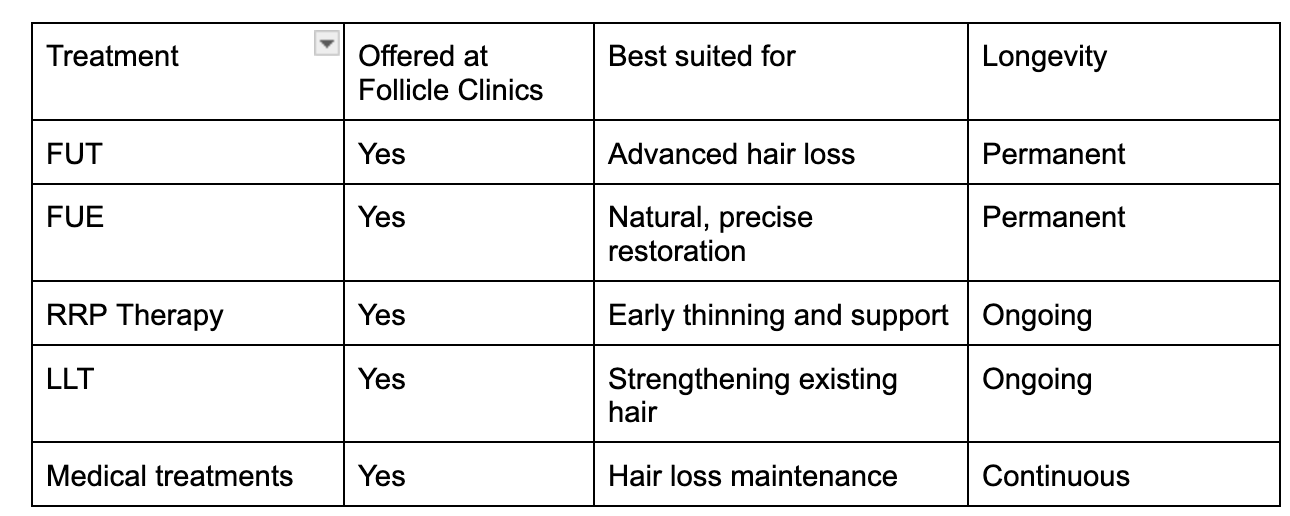
This table lists the reasons why a combination of services generally provides the best overall result for hair restoration and why clinics are essential in providing unique and effective service.
Emerging Trends in Hair Restoration Technologies
Follicle Clinics will always keep updated on technological advances, such as stem cell therapy and future cloning capabilities. However, the focus remains on proven and safe hair restoration options currently available to patients, based on clinically valid information, without exposing patients to unverified or unsupported treatments.
How do I choose the right hair restoration treatment for me?
Choosing the right hair restoration treatment begins with a professional assessment. An expert assessment includes an evaluation of the patient's scalp, a review of their pattern of hair loss, a measure of their donor area (where follicle grafts will be taken from for surgical restoration), and the patient's long-term goals. This process avoids treatment overuse while also ensuring that any newly restored hair will appear as natural as possible due to the continued change of the patient’s hair as time goes on.
The best approach to achieving optimal hair restoration results is often a combination of both surgical and non-surgical options that will preserve the patient’s remaining hair while restoring density to areas of thinning or balding.
Contact Follicle Clinics to arrange an appointment
If you're looking for the best hair restoration treatment available – based on clinical expertise and experience – then Follicle Clinics Australia has everything you need. The focus isn't just on quick fixes but on building long-term, natural-looking solutions that will last.
Contact Follicle Clinics today and make an educated decision regarding the restoration of your hair with a proven team whose focus is on achieving sustainable results using advanced techniques and patient-centred care.